
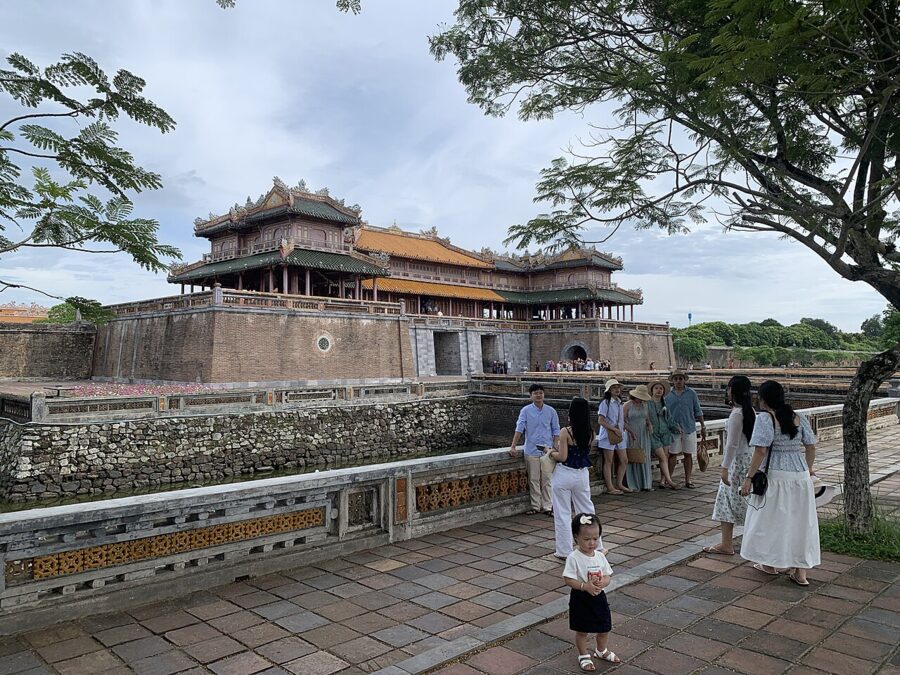
Hue was the capital of Vietnam for 143 years, and the Nguyen emperors who ruled from it left a walled palace city on the north bank of the Perfume River and seven ticketed tombs in the pine hills upstream. Two full days covers the best of it without hurry. The order you see things in matters more than how many you tick off.
It is not a museum town. Hue became one of Vietnam’s centrally governed cities on 1 January 2025, the old citadel is a working neighbourhood with schools and noodle shops inside its walls, and most of the year the place moves at the speed of a bicycle. Compared with Hoi An it is less pretty, less crowded and far better for anyone who wants the history rather than the lanterns.

Contents
Where Hue fits on a trip
Hue sits in the narrow middle of the country, about 100 kilometres south of the Ben Hai River, the line at the 17th parallel that divided North and South Vietnam from 1954 to 1975. So it is neither north nor south but the centre, though in those years it belonged to the South. The name is usually traced to Hóa, from Thuận Hóa, the region Champa ceded to the Vietnamese court in the early 14th century as part of a royal marriage.
Gia Long unified the country in 1802 and made Hue his capital; thirteen emperors later, Bao Dai abdicated in 1945. UNESCO listed the Complex of Hue Monuments as a World Heritage Site in 1993, and the court music, nhã nhạc, has its own UNESCO listing.
Most first trips give Hue one day between Hanoi and Hoi An, and the 10-day itinerary does exactly that, arriving on the night train and leaving on the heritage train over the pass. One day gets you the Imperial City and one tomb. Two days gets you the Imperial City, three tombs, Thien Mu and a proper look at the food, and that is what I would plan for.
The Imperial City (Đại Nội)
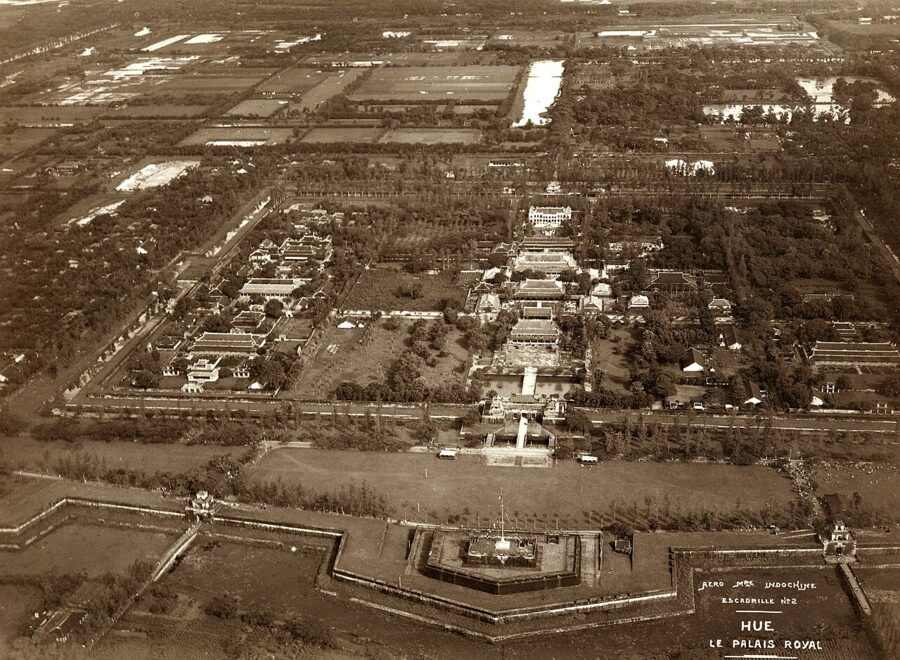
Three walls sit inside each other, and the names confuse everyone. The outer one is the citadel (Kinh thành), a brick rampart about ten kilometres round with a moat, begun under Gia Long in 1805 and finished under his son Minh Mang in 1832. Ordinary streets and houses fill most of it, and you can walk in through its gates for free.
Inside the citadel stands the Imperial City (Hoàng thành), the walled precinct of throne halls, temples and gardens that the ticket covers. At its centre was the Forbidden Purple City (Tử Cấm thành), the emperor’s private quarter. Locals call the whole ticketed enclosure Đại Nội, and so do the signs.
What survives, and what you are looking at
Much of the Imperial City was destroyed in 1947, when French forces retook Hue, and more in the Battle of Hue in early 1968, when the city was fought over street by street for almost a month and thousands of civilians died. What you walk through is part original and part rebuilt, with whole sections still lawn and foundation stones. Knowing that before you go in is the difference between disappointment and interest.
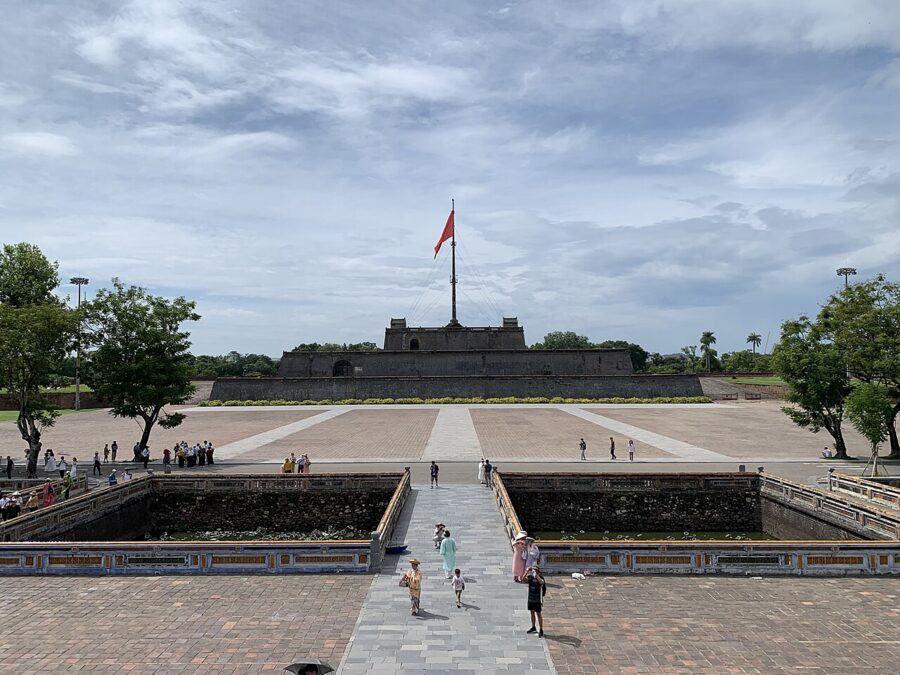
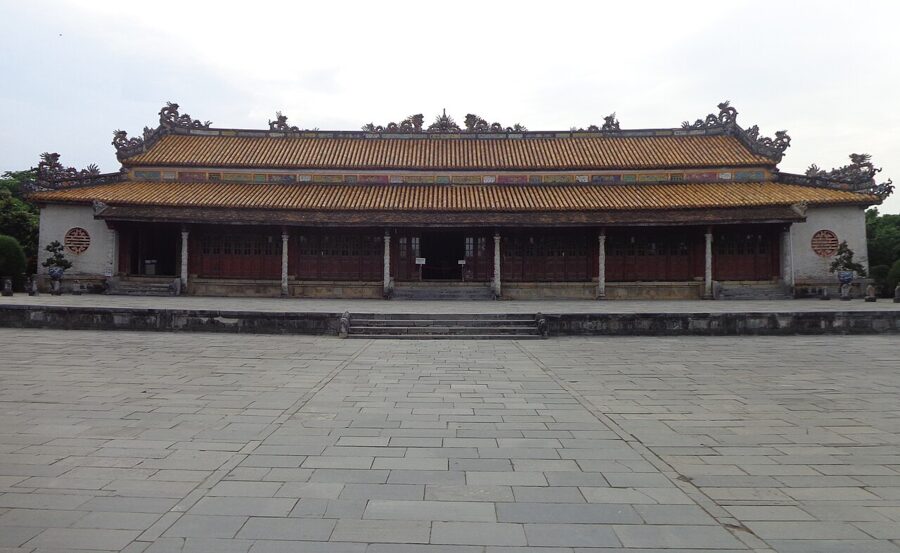
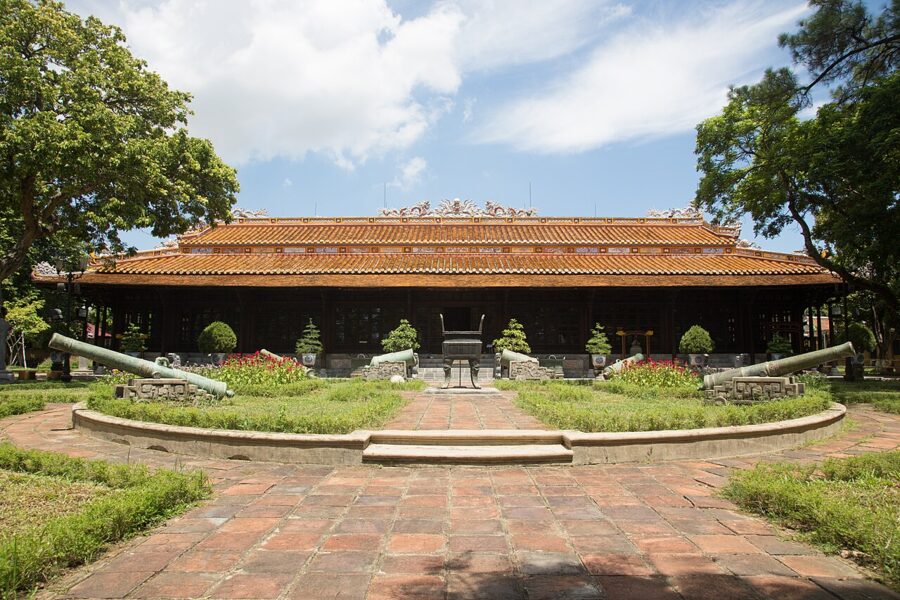
The flag tower (Kỳ Đài) on the citadel wall in front of the Meridian Gate flew the National Liberation Front’s flag for most of that battle. Through the gate, across a courtyard and a small bridge, is Thai Hoa Palace (Điện Thái Hòa), the throne hall where the Nguyen emperors were crowned. It closed in 2021 for a three-year restoration and reopened on 23 November 2024 with the dynasty’s gilded throne back inside, and it is the one interior you should not skip.


Behind it, the Forbidden Purple City is mostly gone. Its gate, Đại Cung Môn, destroyed in 1947, is being rebuilt from 2026 to 2030, and Can Chanh Palace (Điện Cần Chánh), the emperor’s working hall, is due to be finished in 2029. Expect scaffolding and screened-off areas in the middle of the site for years.
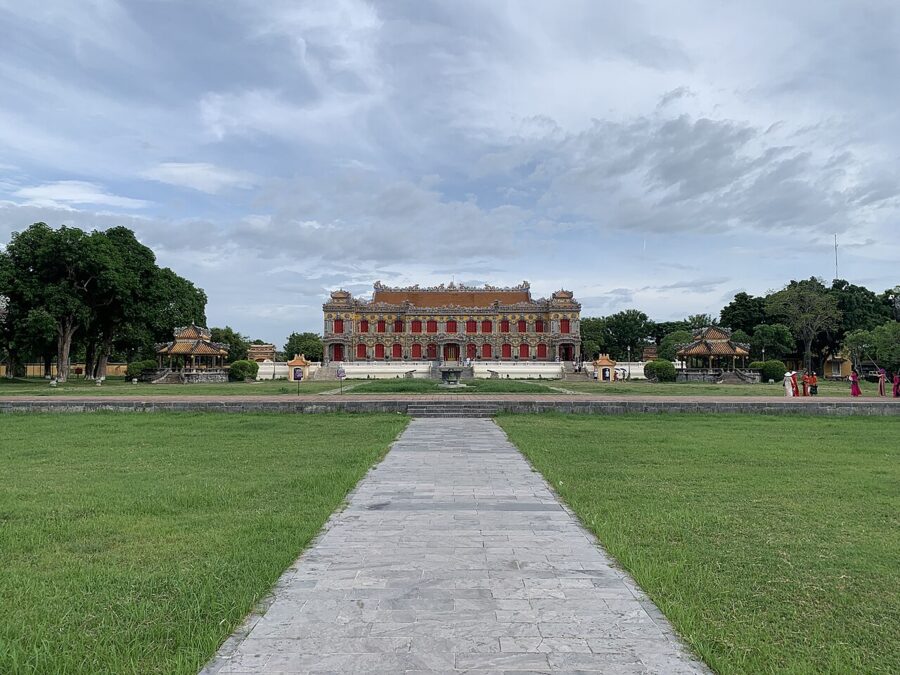
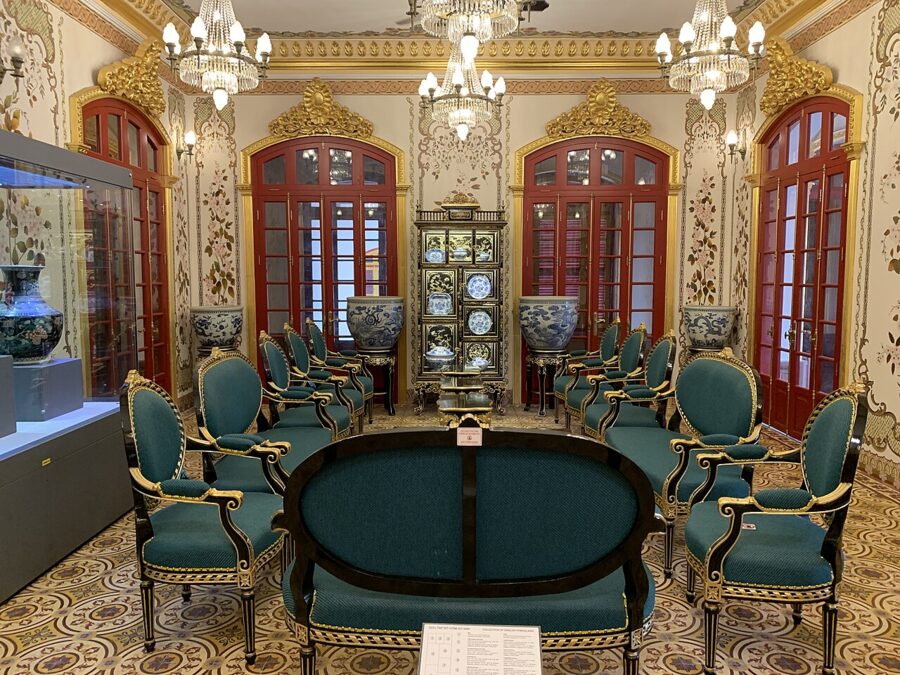
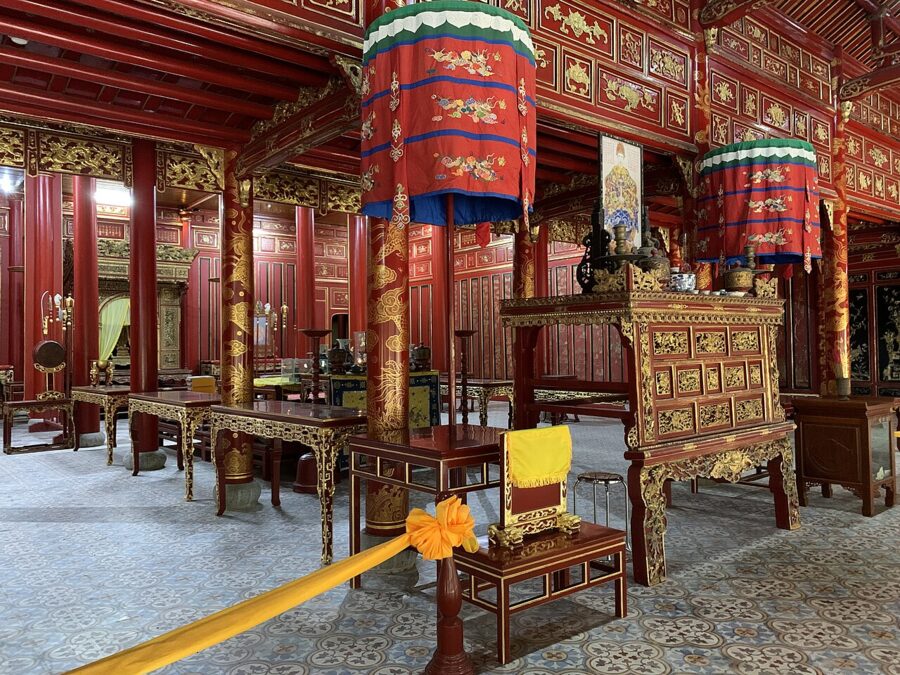
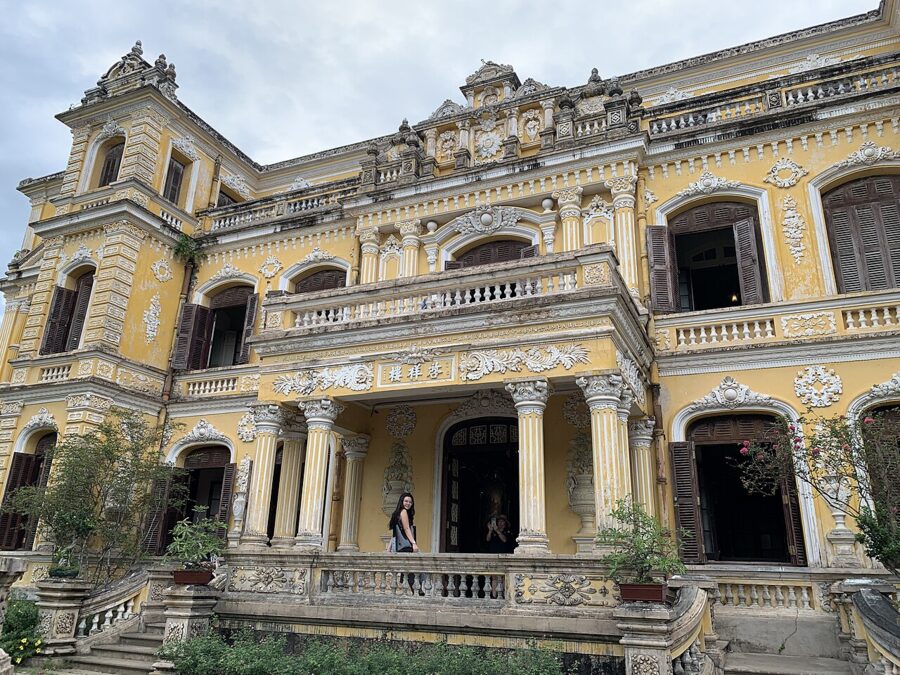
At the back of that open ground stands Kien Trung Palace (Điện Kiến Trung), built for Khai Dinh between 1921 and 1923 in a mix of European and Vietnamese styles. It was almost completely destroyed in 1947, rebuilt over five years and reopened at Tet in February 2024, with the chandeliers and patterned tile floors of a 1920s court that was busy copying France.


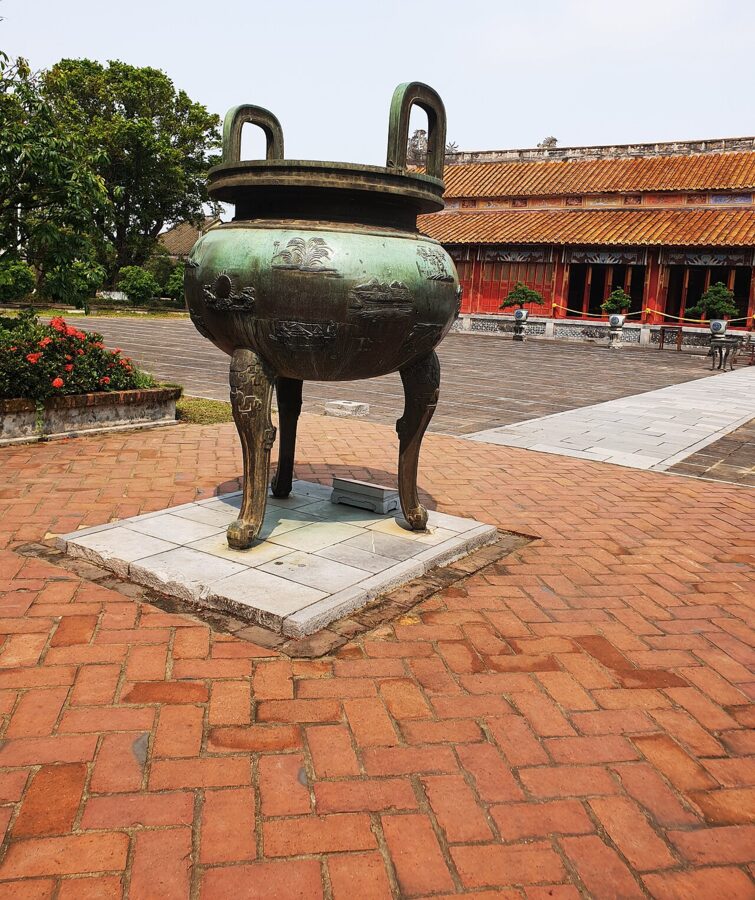
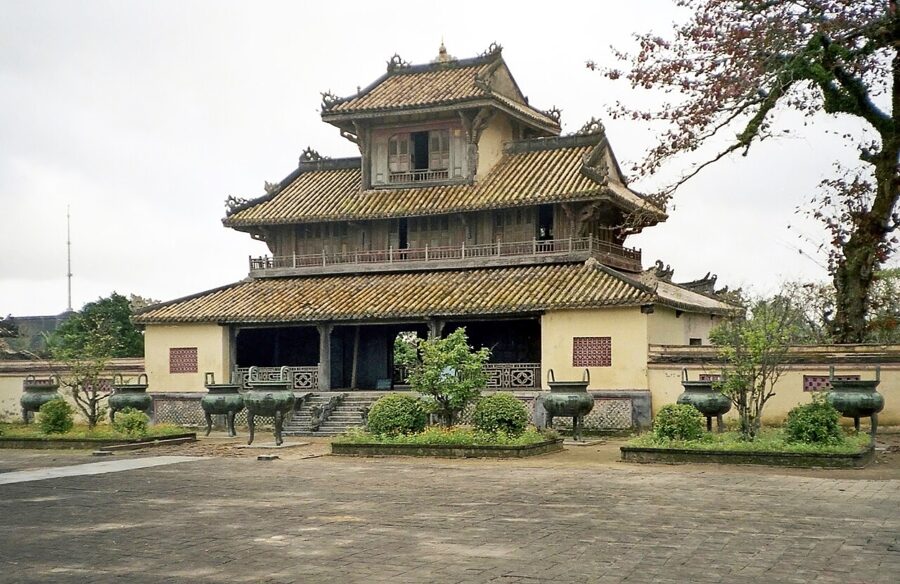
West of the main axis, The Mieu temple (Thế Miếu) holds the altars of the Nguyen emperors, and in its courtyard stand the Nine Dynastic Urns (Cửu Đỉnh), bronze cauldrons cast in the 1830s and decorated with the rivers, mountains, animals and weapons of the country. Facing them is Hien Lam Cac, a three-storey wooden pavilion from the 1820s.


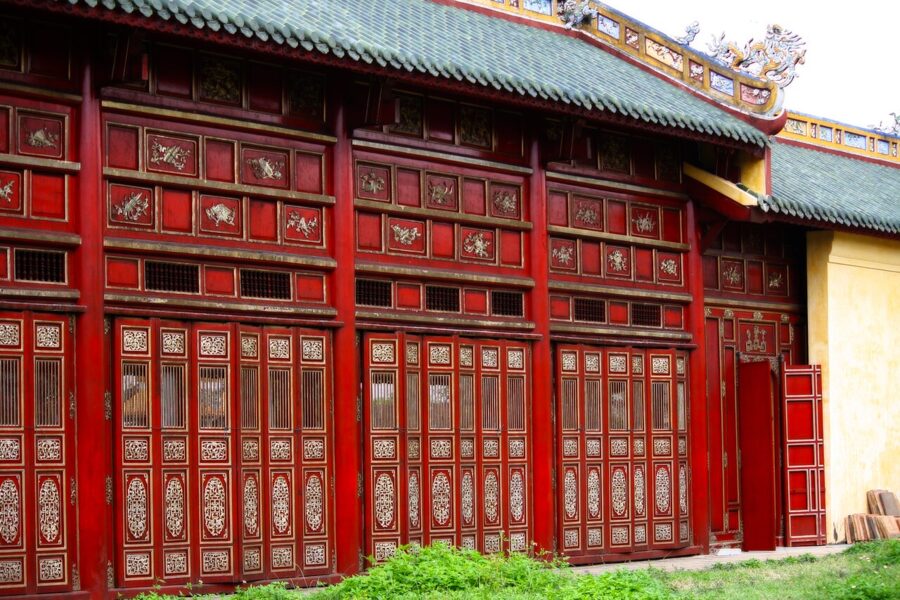
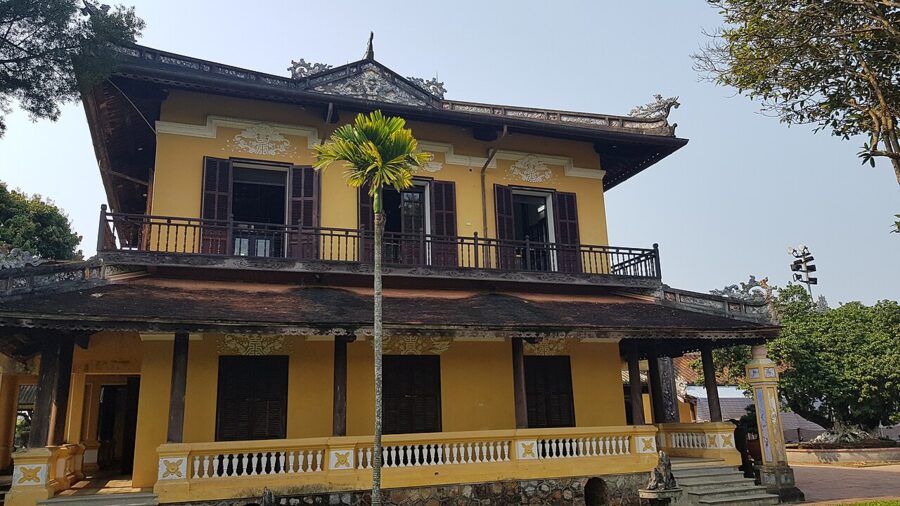
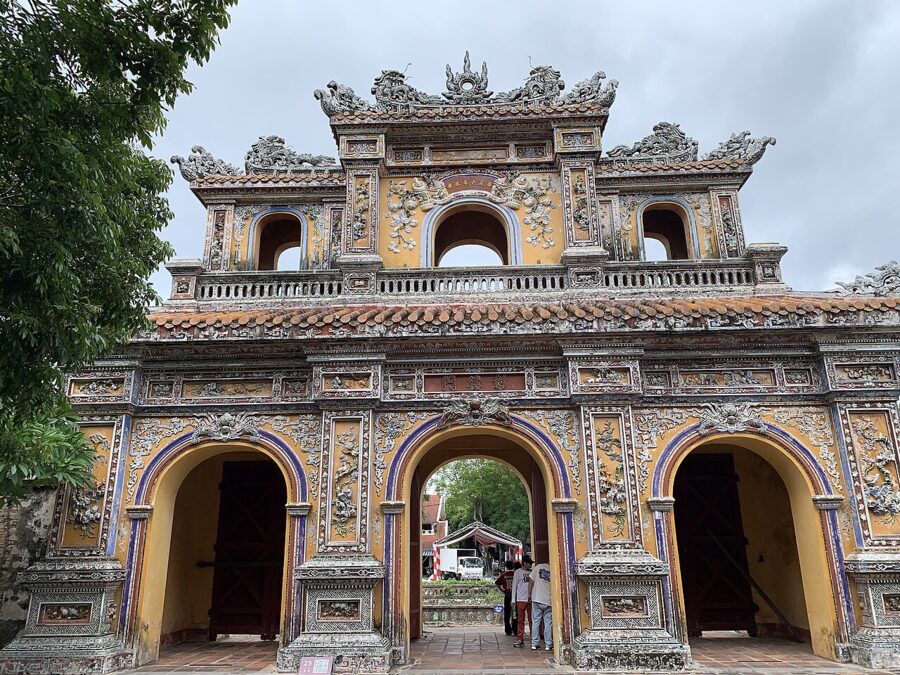
The long covered corridors, restored with their lacquered red and gold panels, are the place to be when a storm comes through. On the western side, the Dien Tho Palace compound, the queen mother’s residence, has a two-storey building that looks more like a colonial villa than a palace. Leave by Hien Nhon Gate on the east side for the walk back to the river.



Tickets, hours and how long
The Hue Monuments Conservation Centre (Trung tâm Bảo tồn Di tích Cố đô Huế) runs the Imperial City and the tombs, sells tickets at each gate and online, and charges Vietnamese and foreign visitors the same. These are its prices as of November 2026:
| Ticket | Adult | Child (7 to 12) |
|---|---|---|
| Imperial City (Đại Nội) | 200,000 dong (about $8) | 40,000 dong (about $1.50) |
| Tombs of Minh Mang, Tu Duc or Khai Dinh, each | 150,000 dong (about $6) | 30,000 dong (about $1) |
| Imperial City plus any two of those three tombs | 420,000 dong (about $16) | 80,000 dong (about $3) |
| Imperial City plus all three tombs | 530,000 dong (about $20) | 100,000 dong (about $4) |
| All sites run by the centre | 600,000 dong (about $23) | 120,000 dong (about $4.50) |
| Tombs of Gia Long (150,000), Dong Khanh (100,000), Thieu Tri or Duc Duc (50,000 each) | About $6, $4 and $2 | Free |
The combined tickets are valid for two days and the all-sites ticket for five, which is the main reason to buy one. The four-site ticket also saves 120,000 dong (about $5) on the same entries bought separately.
The gates open early in the morning and close in the late afternoon, with longer hours in summer; the centre’s ticket office publishes the current times. In November 2026 the city also halved entry to five sites (the Imperial City, the Royal Antiquities Museum and the tombs of Thieu Tri, Duc Duc and Dong Khanh) for holders of a heritage train ticket to or from Da Nang or Phong Nha, within seven days of the journey: one discounted entry per train ticket.
Give the Imperial City three hours. The English signs are thin in places, so if you care about the history, take one of the centre’s own guided tours, sold as a separate ticket; a good guide earns the fee here more than anywhere else in Hue. Go at opening time: the tour groups arrive mid-morning, and by noon in summer the stone courtyards are an oven.
The royal tombs: which to choose
The Nguyen emperors chose their burial sites in their own lifetimes and often built them while still in power, so each tomb is a portrait of the man. They lie south and south-west of the city along both banks of the Perfume River, between about 6 and 16 kilometres out. If you have time for three, make it Khai Dinh, Minh Mang and Tu Duc, the three on the combined tickets.
Khai Dinh: concrete, porcelain and ambition
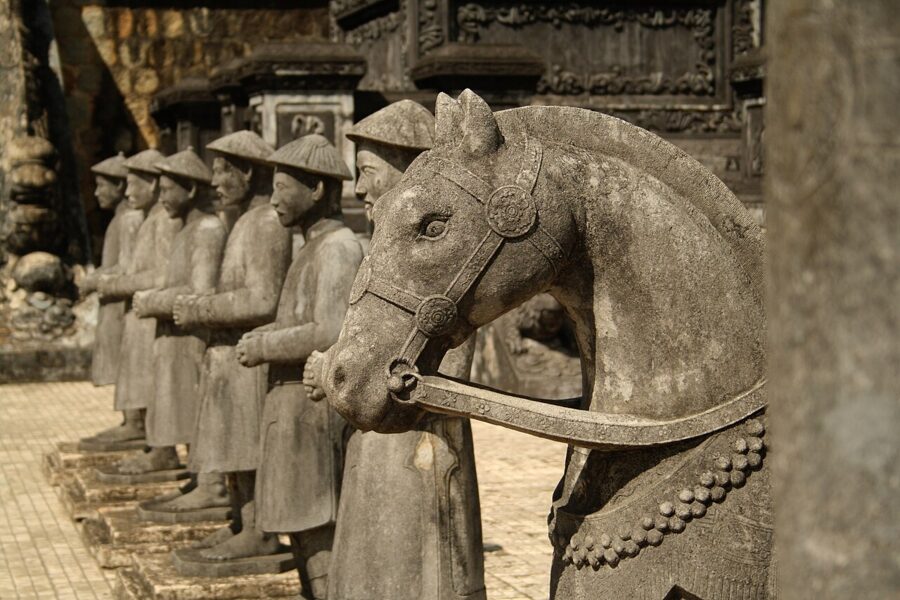
Khai Dinh ruled from 1916 to 1925 and was widely seen as a French puppet, and he raised taxes to pay for this tomb, which was finished in 1931, six years after his death. It climbs a steep hillside in terraces, built of reinforced concrete rather than wood and brick, borrowing from Europe and Asia at once. You will find it brilliant or vulgar, and probably both.
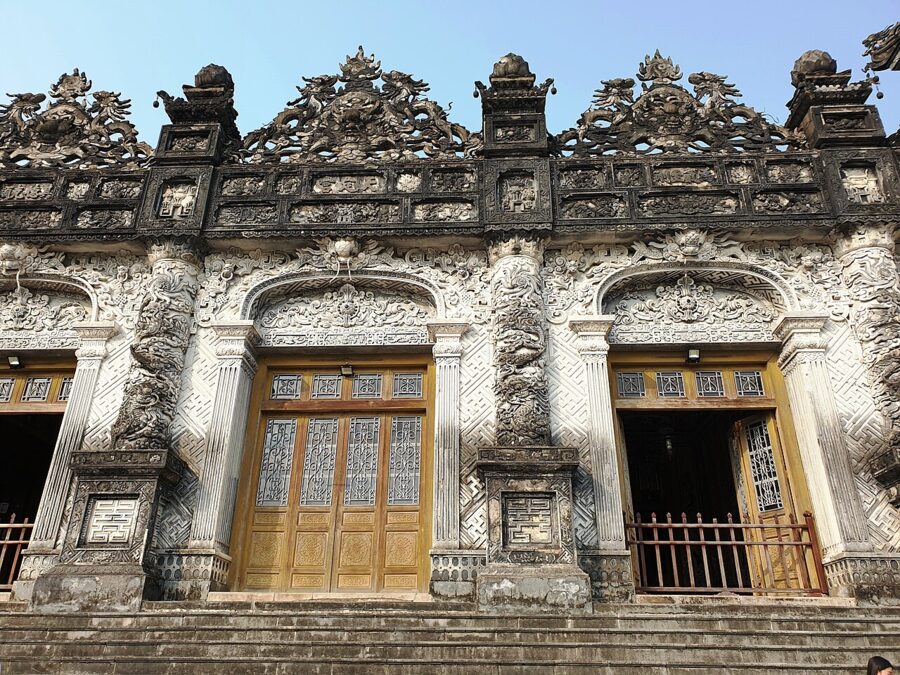

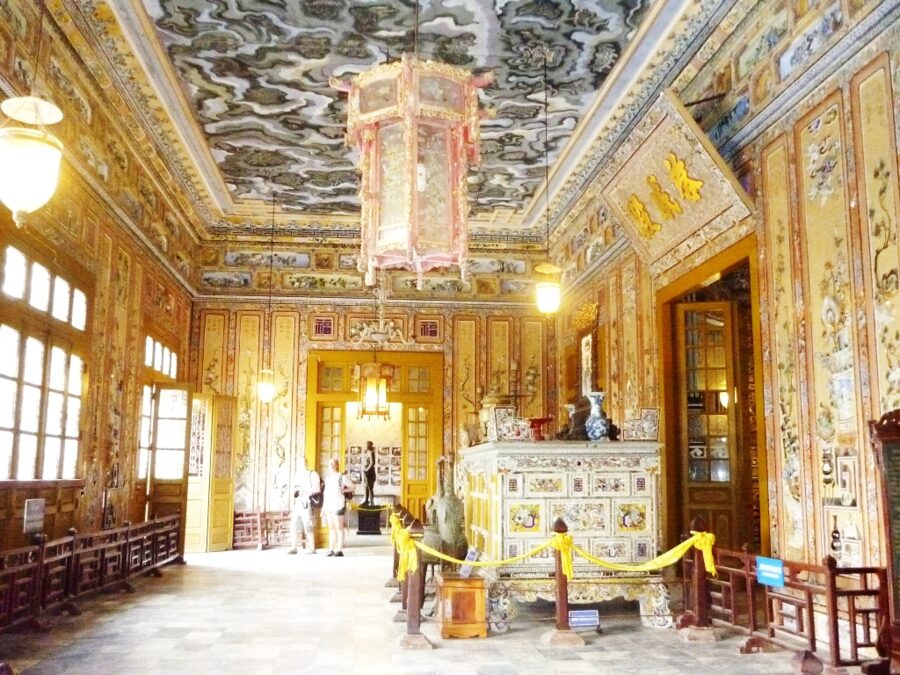
The interior of that top building, Khai Thanh Palace (Điện Khải Thành), is the reason to come. Every surface is covered in mosaics of broken porcelain and coloured glass, the ceiling is painted with dragons in clouds, and under a canopy sits a gilded bronze statue of the emperor cast in France. His remains lie beneath it.


Minh Mang: the most complete design
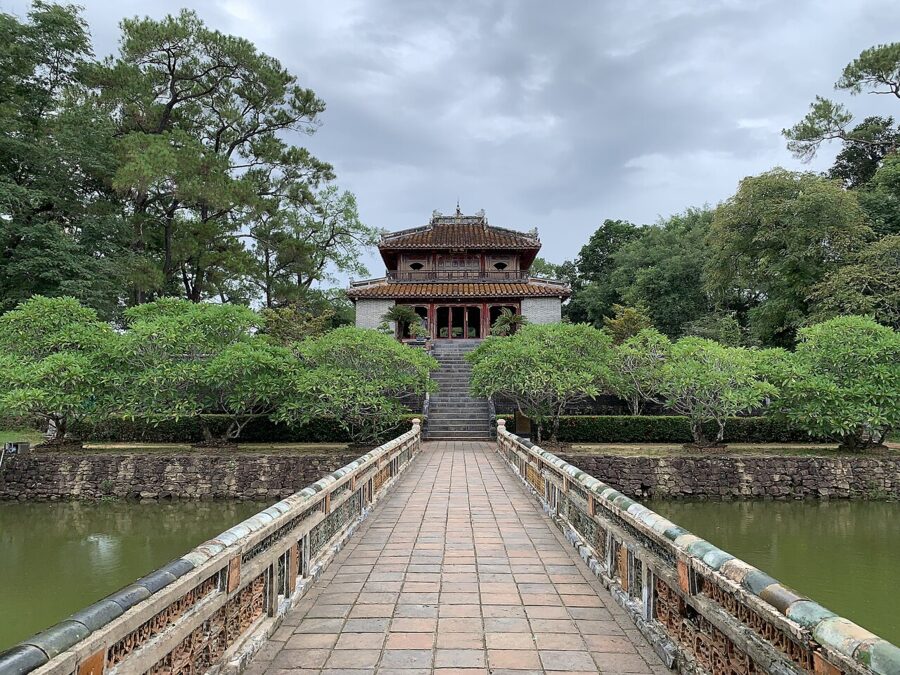
Minh Mang’s tomb, begun in 1840 and finished in 1843 under his son Thieu Tri, is the opposite of Khai Dinh: low, symmetrical and set among lakes and pine trees. Everything lines up along one axis, from the entrance gate through the stele pavilion and the temple, across bridges and lakes, to the walled burial mound at the end, which you cannot enter.
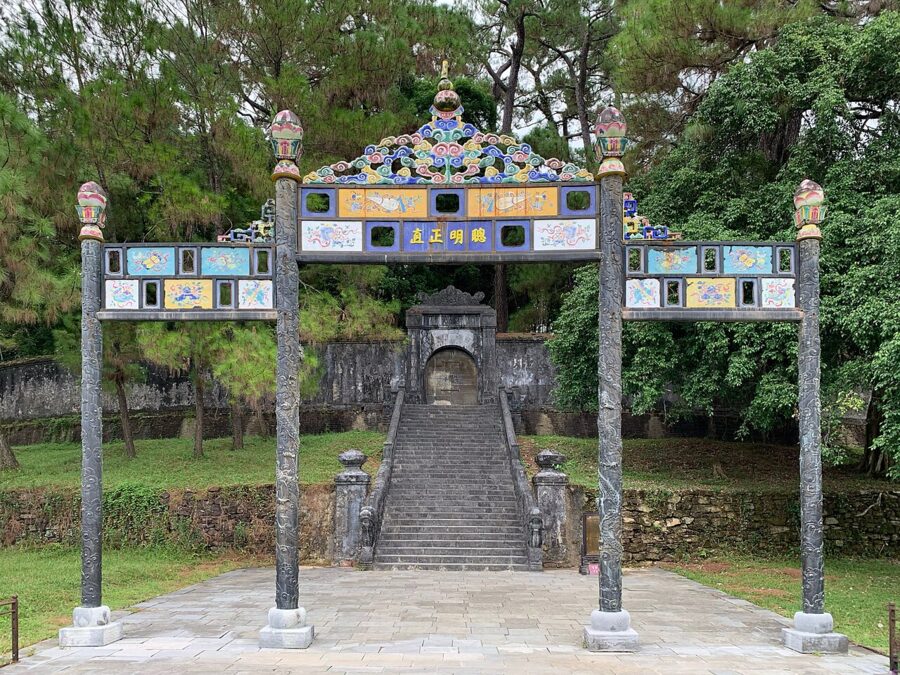

It is the furthest of the three from the city, about 12 kilometres, and the one most worth an unhurried visit. The walk from the gate to the far end and back takes an hour at an easy pace.

Tu Duc: a retreat with a grievance
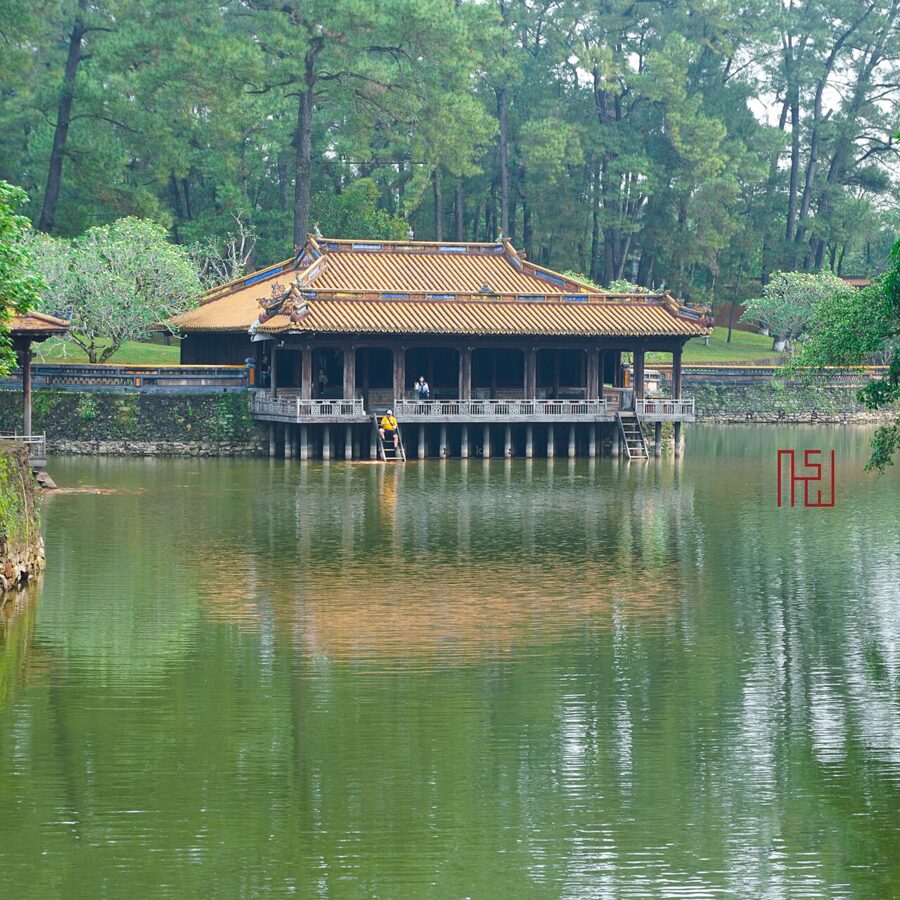
Tu Duc reigned for 36 years, longer than any other Nguyen emperor, and used his tomb as a country retreat for years before he died in 1883. He built it between 1864 and 1867, with pavilions over a lotus lake where he wrote poetry, and a theatre. The forced labour behind it was so harsh that the workers rose in revolt in 1866, and a rhyme mocking the project is still quoted in Hue.

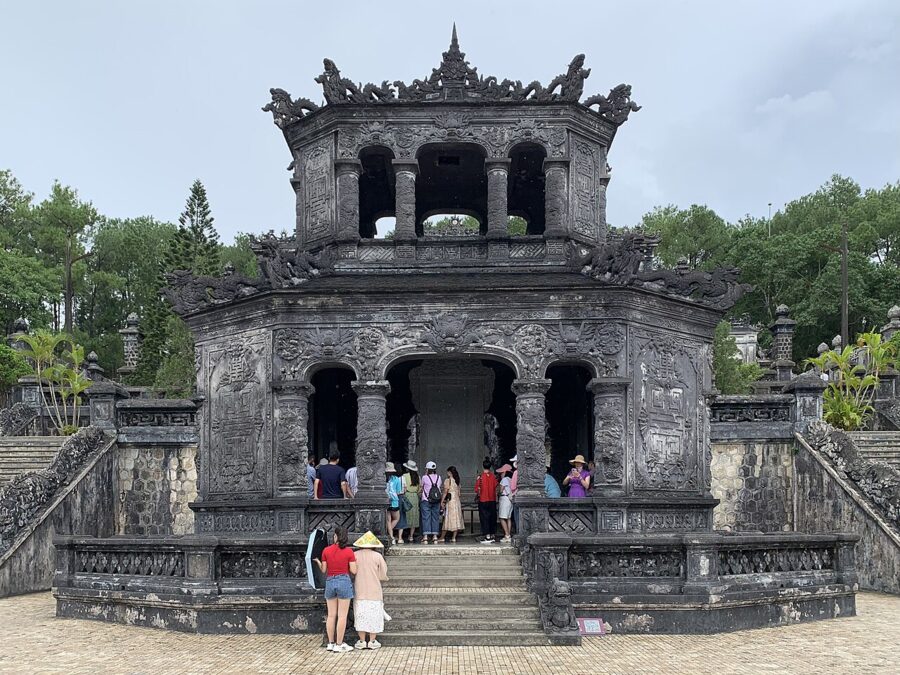
The stele pavilion holds one of the largest steles in Vietnam, carved with a long text in which Tu Duc set down his own failings, and the grave behind it is said not to hold his body, which was buried in secret elsewhere. Tu Duc’s is the closest of the three, about six kilometres out. Dong Khanh’s smaller tomb is a short walk away and shares a 200,000 dong (about $8) combined ticket with it.

Gia Long and the quiet ones
Gia Long’s tomb, about 16 kilometres south of the city on the west bank, is the founder’s and the least visited of the big ones, because it is far and partly ruined. The emperor and his queen lie side by side in two plain stone graves, which is moving after the grandeur of his successors. A restoration of its collapsed Thoai Thanh Palace is due to start in late 2026.
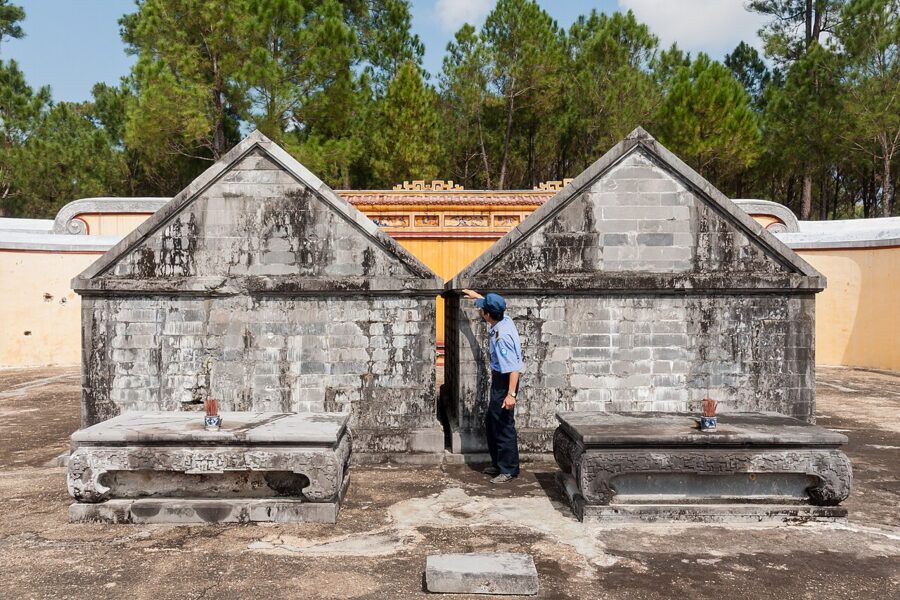

Thieu Tri’s and Duc Duc’s tombs see very few visitors, and I would leave them for a third day. At any tomb, ask whether part of the site is closed for restoration before you buy, and carry water: the drinks stalls at the gates charge well over town prices.
Getting to the tombs
The tombs are too spread out to walk between. Most people use one of four ways:
- Grab or a metered taxi to each tomb. Simple at Tu Duc and Khai Dinh; at Minh Mang and Gia Long you may wait a long time for a pick-up, so ask the first driver to wait.
- A car with driver for the day. The easiest way, and your hotel can arrange it. Agree the route, the hours and whether tickets are included before you leave.
- A motorbike, only if you hold a licence valid in Vietnam; your travel insurance usually depends on it.
- A bicycle for Tu Duc and the closer sites. Khai Dinh and Minh Mang are a long, hot ride.
Run the route as a loop: Tu Duc and Dong Khanh first, Khai Dinh second, Minh Mang last. That puts Khai Dinh’s stairs before the worst of the heat. If you want the history as well as the views, this is the day a guide pays, and a fair private tomb day includes the car, the route and the explanations, with tickets either included or clearly listed as extra.
Thien Mu Pagoda and the Perfume River
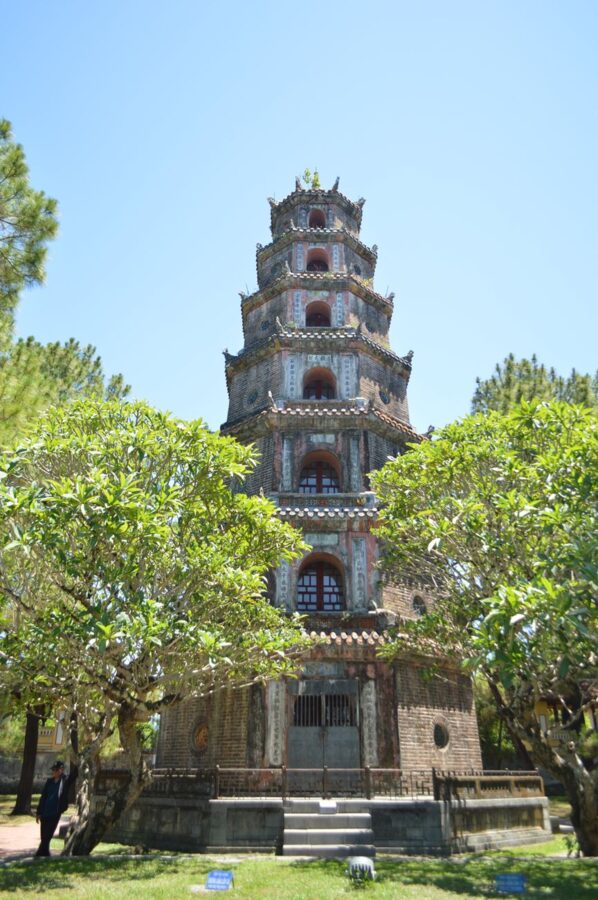
Thien Mu Pagoda (Chùa Thiên Mụ) stands on a low hill on the north bank, about four kilometres upstream of the citadel, and is the oldest pagoda in Hue. It was founded in 1601 by Nguyen Hoang, the first of the Nguyen lords, and its seven-storey octagonal tower, Phuoc Duyen, was added in 1844. Entry is free, and monks still live and study here, so cover shoulders and knees.
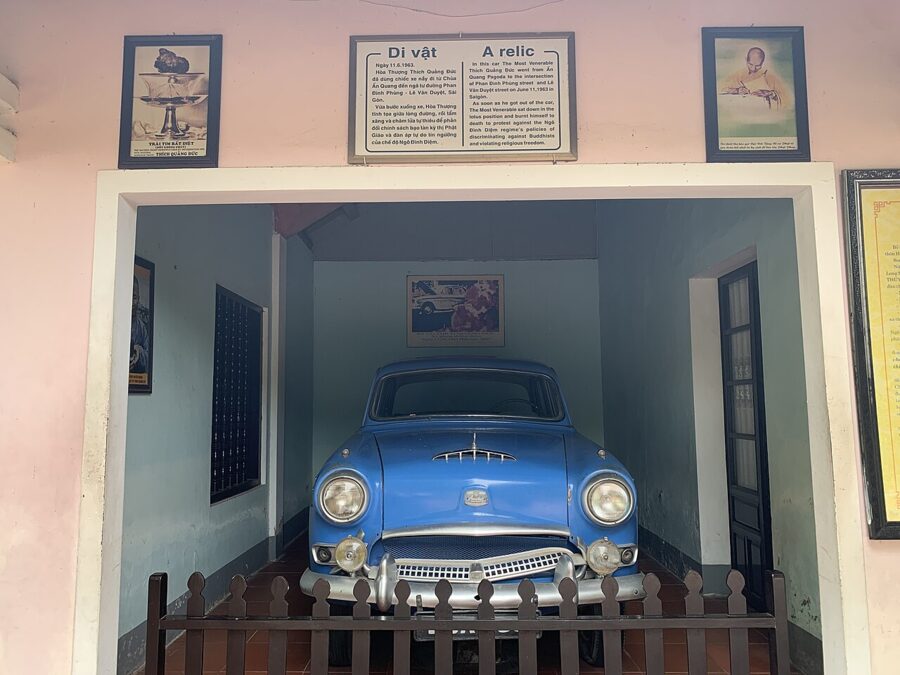
Behind the main hall, in a garage of its own, is a pale blue Austin car. It carried the monk Thich Quang Duc to a Saigon crossroads on 11 June 1963, where he burned himself to death in protest at the Diem government’s treatment of Buddhists. The photograph of that morning went round the world, and it hangs beside the car.

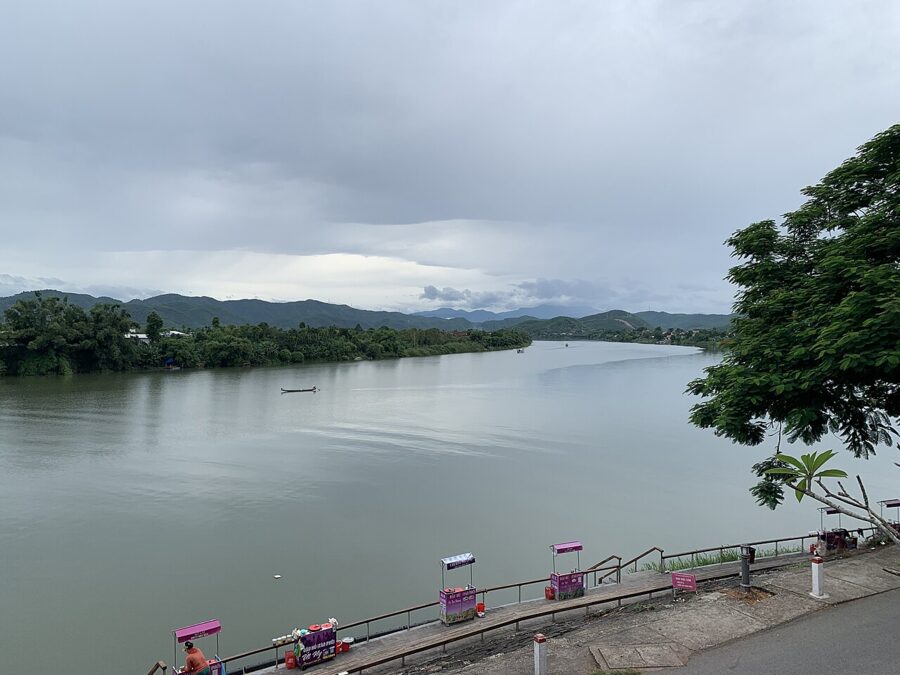

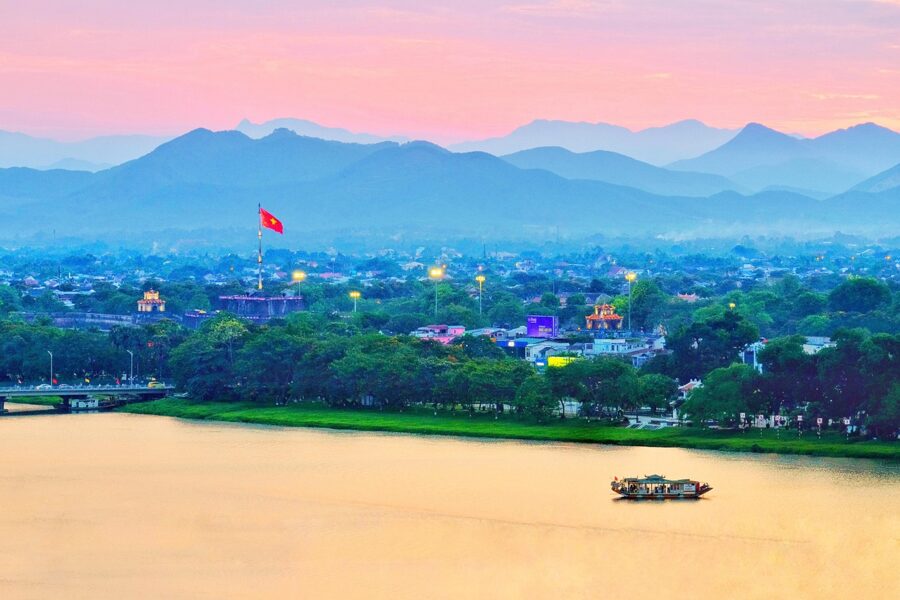
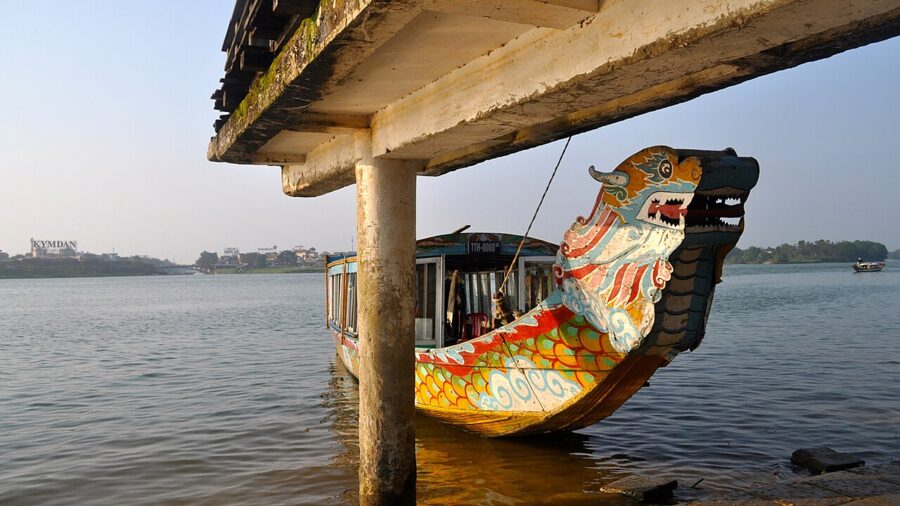
The Perfume River (Sông Hương) is slow, green and wide, and the dragon boats that work it are the easiest way to reach Thien Mu without traffic. They leave from the south bank in the centre; agree a price for the boat, not per person, and how long it will wait. In the evening some boats carry singers of ca Huế, the city’s chamber song with zither and lute, which is better than it sounds on a tourist programme.

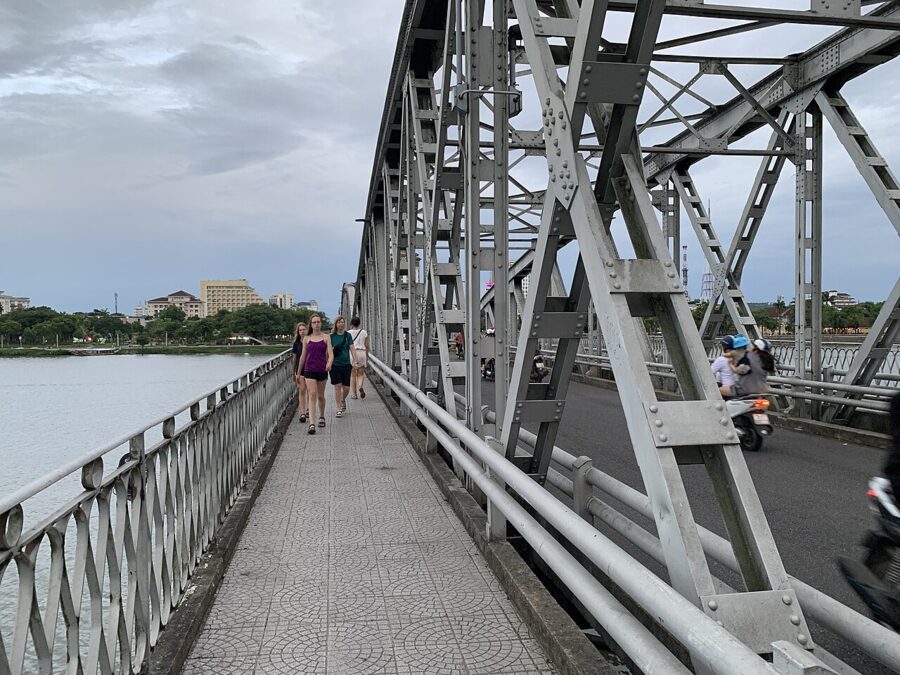
Truong Tien Bridge (Cầu Trường Tiền), the steel truss bridge that has crossed the river in the centre since 1899, has been wrecked by typhoon and war and rebuilt more than once. It is lit at night and makes a good walk between the banks.

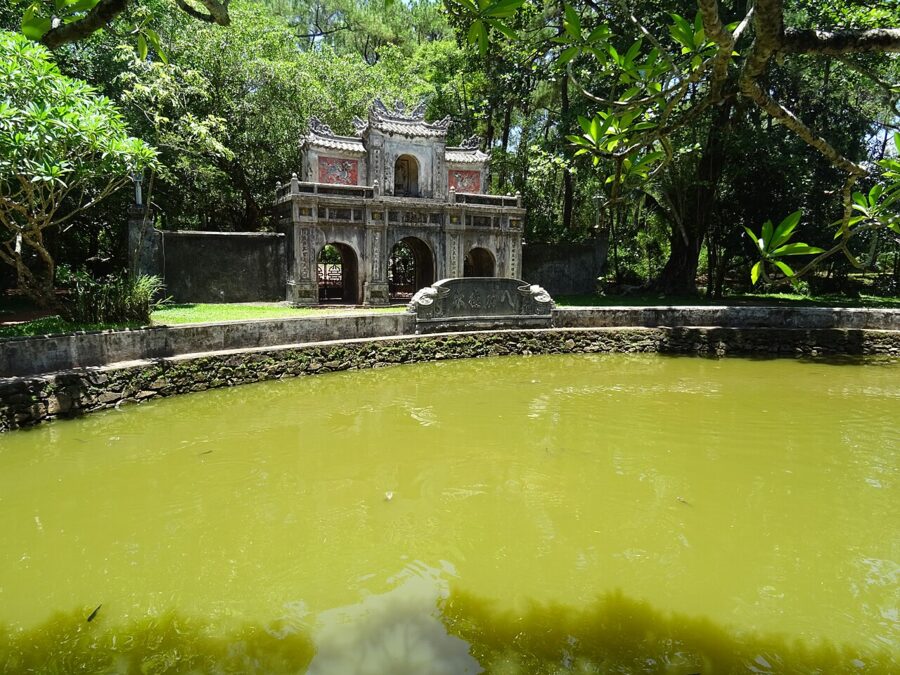
For a quieter pagoda, Tu Hieu (Chùa Từ Hiếu), in the pine hills near Tu Duc’s tomb, was the root temple of the Zen teacher Thich Nhat Hanh, who was ordained there in the 1940s and returned to die there in January 2022. There is a crescent pond, a cemetery for court eunuchs and, most mornings, almost nobody else.

The rest of the city
A few smaller sites fill a rainy afternoon. The Royal Antiquities Museum (Bảo tàng Cổ vật Cung đình Huế), in Long An Palace inside the citadel, holds court costume, ceramics and furniture, and costs 50,000 dong (about $2). An Dinh Palace (Cung An Định), on the An Cuu canal south of the river, was Khai Dinh’s private residence; a combined ticket for both costs 80,000 dong (about $3).


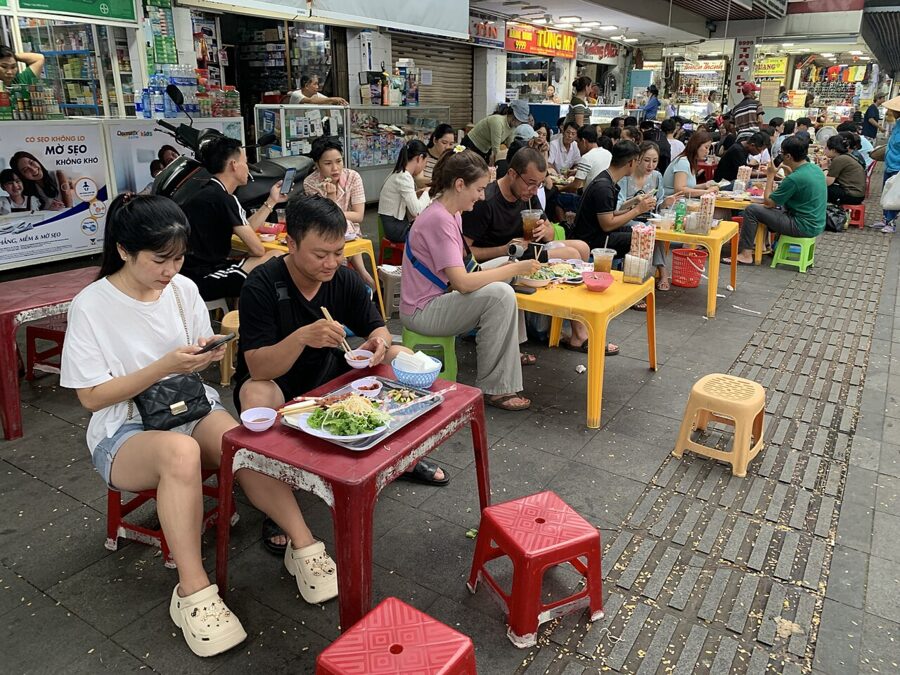
Dong Ba Market (Chợ Đông Ba), on the north bank by Truong Tien Bridge, is the oldest and biggest market in town, with a food hall that does breakfast for half the neighbourhood. Bargain for anything that is not food.

With an extra day, the Tam Giang Lagoon north of the city is a broad, shallow expanse of fishing stakes and nets, best at sunrise, and the DMZ further north takes a long day in a vehicle for the Vinh Moc tunnels and the old American bases around Khe Sanh.

What to eat in Hue
Hue cooks spicier food than the rest of the country, and the court left it a taste for many small dishes presented with care. Its Buddhist tradition means vegetarian restaurants (quán chay) are easy to find. Royal-style set dinners served in costume are a show more than a meal; I would eat on the street and spend the difference on a second bowl of noodles.
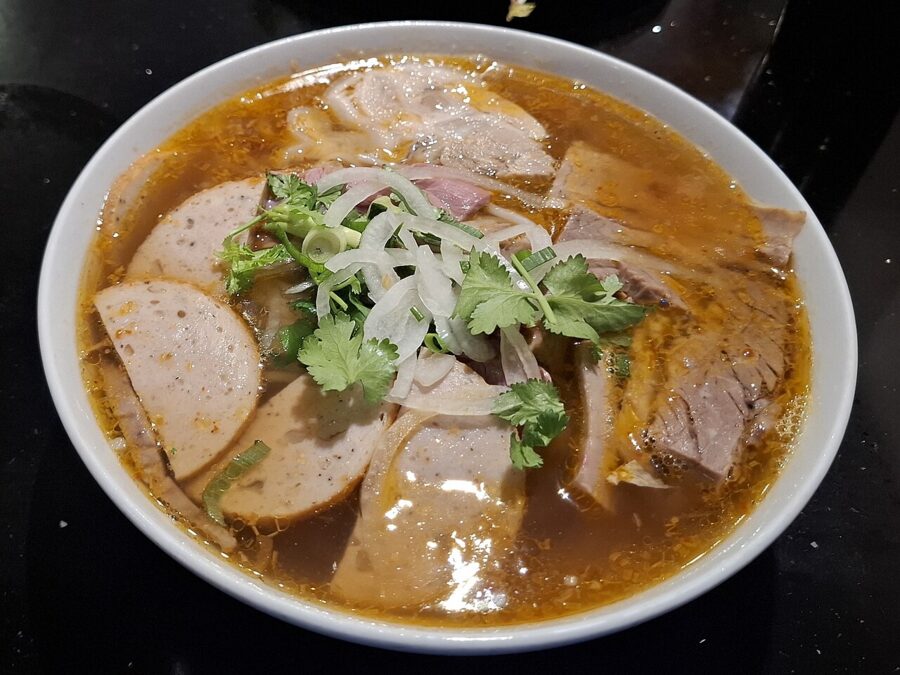
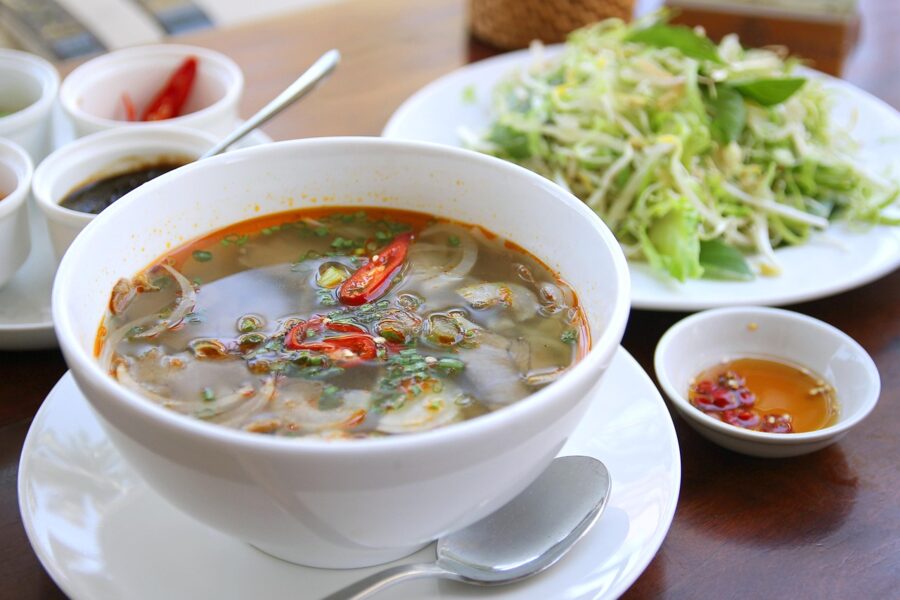
Start with bún bò Huế (spicy beef and lemongrass noodle soup). The broth is built on beef bones and fermented shrimp paste (mắm ruốc), coloured with chilli oil, and the bowl holds round noodles, beef shank, pork knuckle and sometimes cubes of blood. It is nothing like pho, and in Hue it is mostly a breakfast dish.

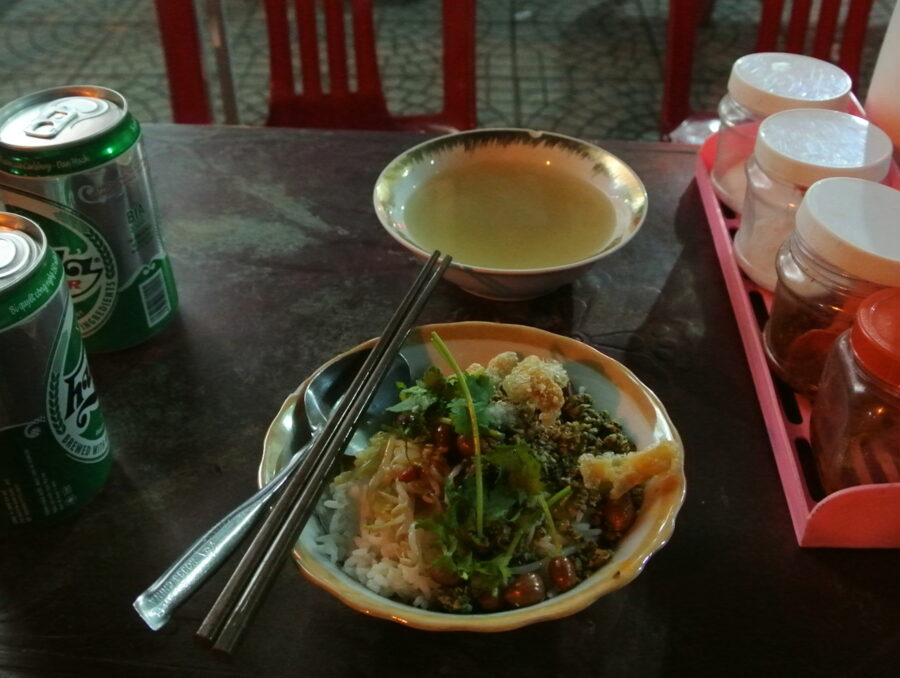
Then cơm hến (rice with baby river clams), the cheapest and most local of the Hue dishes. Rice is mixed with tiny clams, peanuts, pork crackling, herbs and chilli, with a bowl of clam broth on the side. It came from Cồn Hến, the islet in the Perfume River where the clams were once gathered, and people either love it or never order it twice.

The bánh come next, small rice and tapioca cakes best eaten as a mixed plate:
- Bánh bèo: tiny steamed rice cakes in saucers, topped with dried shrimp and crackling, eaten with fish sauce.
- Bánh nậm: flat rice cakes with shrimp and pork, steamed in banana leaf.
- Bánh lọc: chewy, clear tapioca dumplings with a whole shrimp and pork inside.
- Bánh khoái: Hue’s crisp pancake, served with a thick peanut sauce rather than fish sauce.
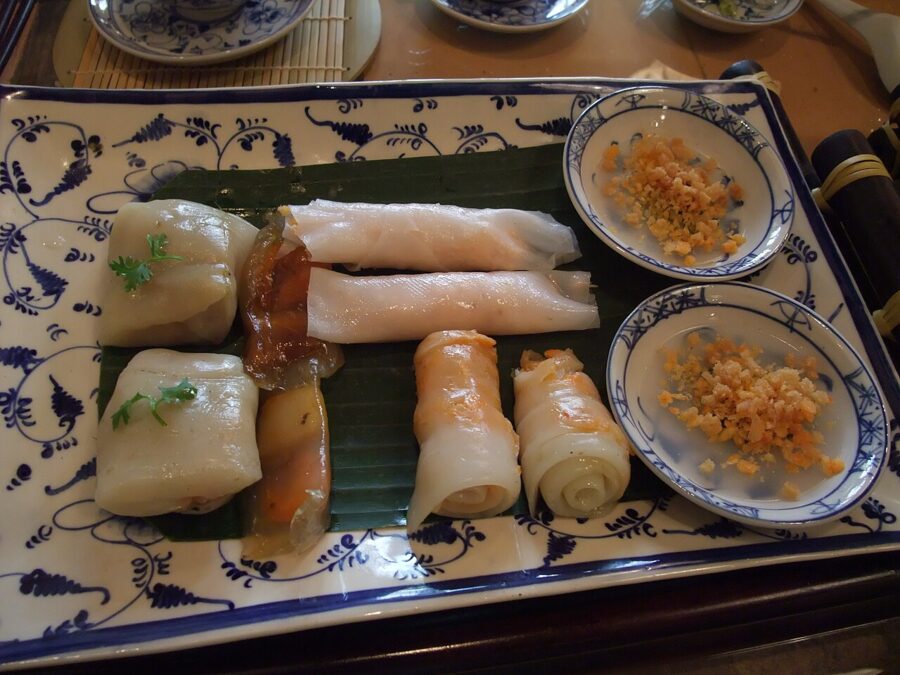

Finish with nem lụi (pork grilled on lemongrass sticks, rolled in rice paper with herbs) and a glass of chè (sweet soup), which Hue makes in dozens of kinds. For a souvenir, mè xửng, the chewy sesame and peanut candy, travels well.
Getting to Hue
By train
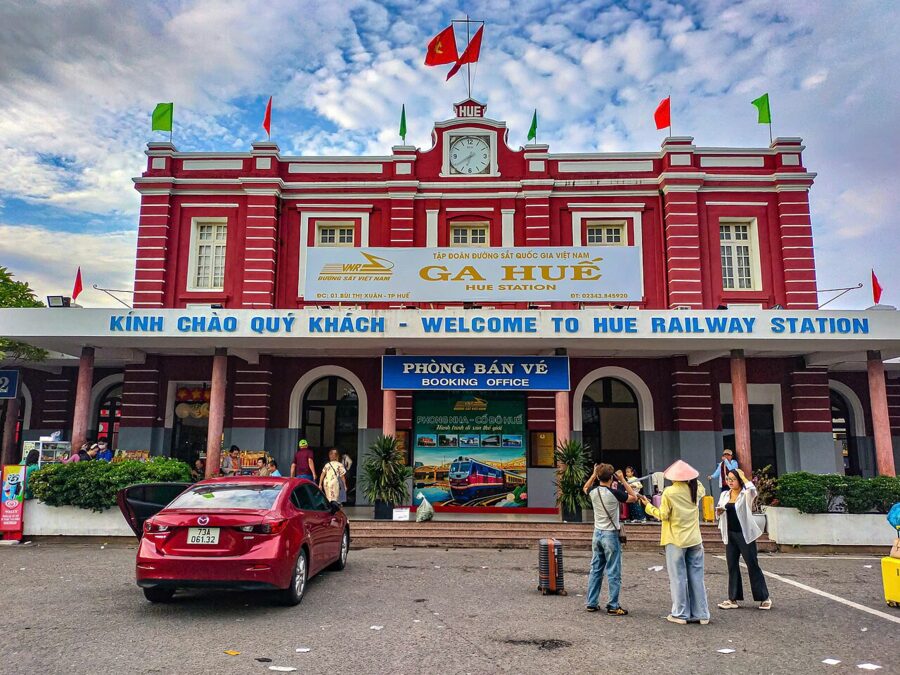
Hue Railway Station (Ga Huế), on the south bank west of the centre, is on the main north-south line. Overnight sleepers from Hanoi take roughly 12 to 16 hours depending on the train, and the 10-day itinerary gives times and Vietnam Railways’ fares for the fastest. From Ho Chi Minh City it is most of a day and a night, and I would fly.

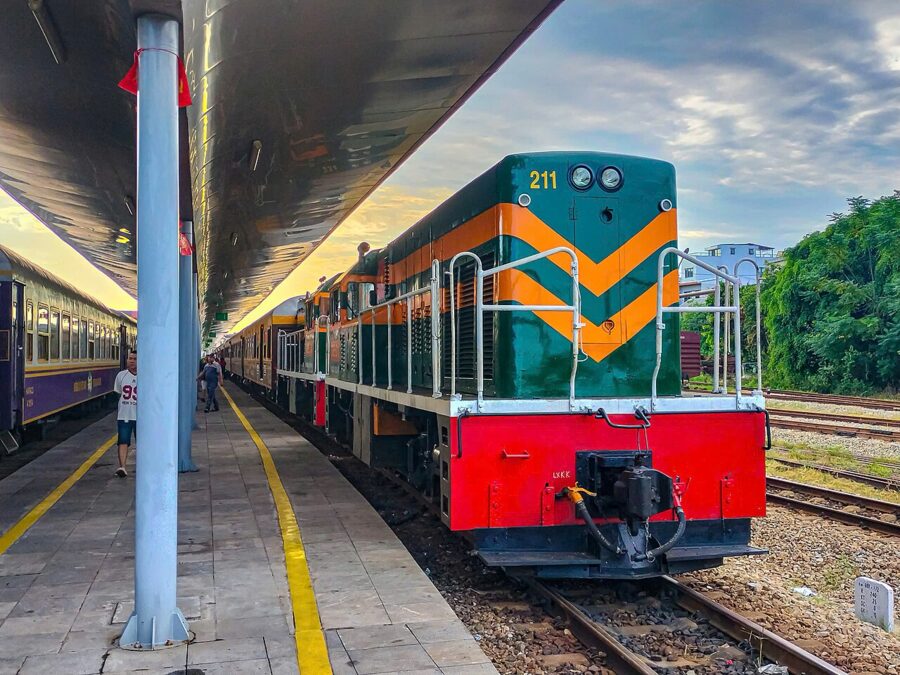
Two tourist services start here. The “Kết nối di sản” (Heritage Connection) train to Da Nang runs twice a day each way, in the morning and the afternoon; check the current times when you book. The trip takes about three hours, with fares from 150,000 dong (about $6). Since August 2026 a second heritage train runs north to Tho Loc, near Phong Nha: HQ2 leaves Hue at 07:15 and arrives at 11:55, and HQ1 comes back at 13:15, reaching Hue at 17:25.

Over the Hai Van Pass
Between Hue and Da Nang the mountains come down to the sea, and the Hai Van Pass (Đèo Hải Vân) crosses them. Cars and buses now take the tunnel underneath, about two to two and a half hours from Hue to Da Nang, but the railway still runs round the cliffs above the water, and that stretch is the reason to take the train at least once. Sit on the sea side: the left heading south.
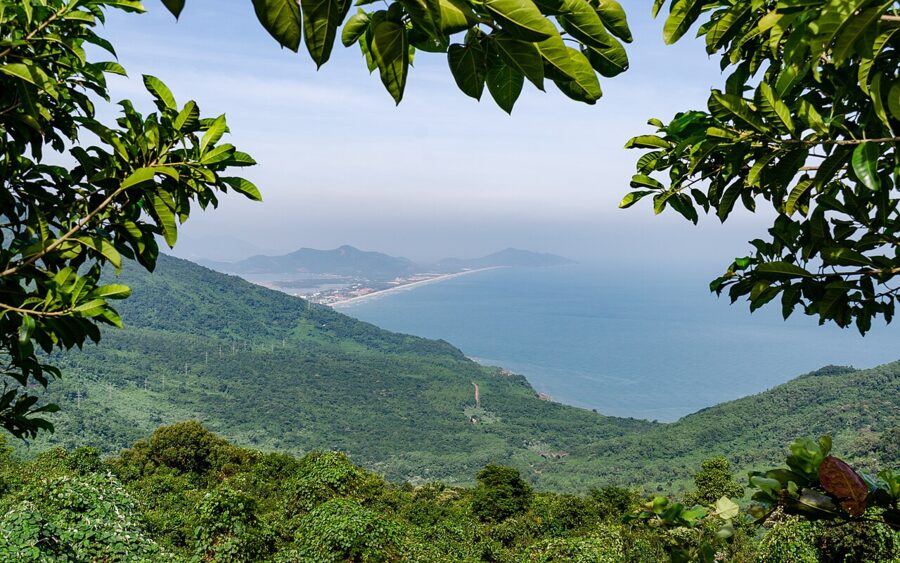

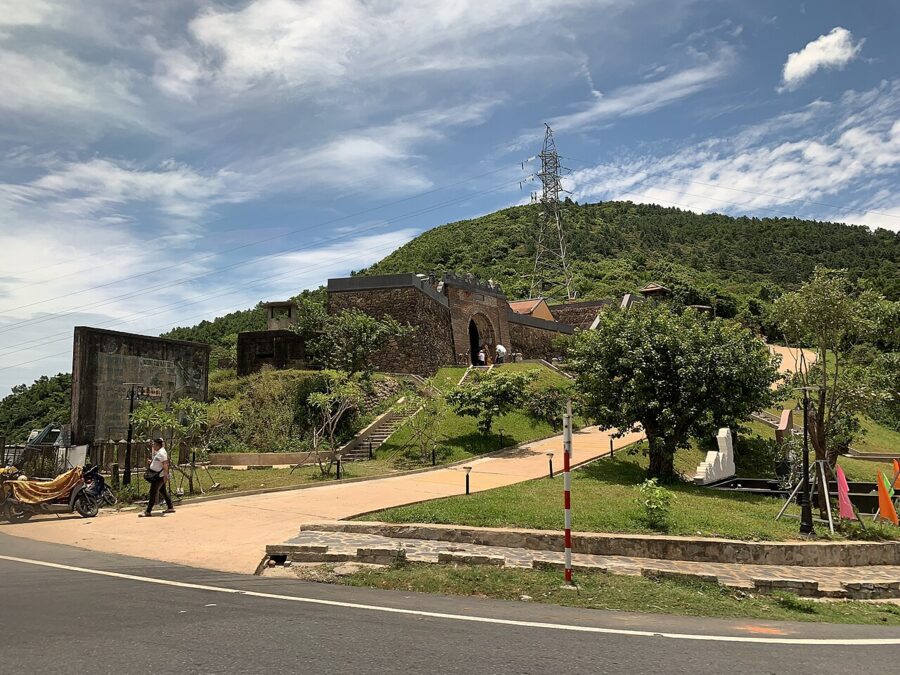
Motorbikes are not allowed in the tunnel, so riders still use the old road over the top, and at the summit stands Hai Van Gate (Hải Vân Quan), the fortified gate built under Minh Mang. The Hue conservation centre charges 70,000 dong (about $3) to enter it.

By air and by bus
Phu Bai International Airport is about 15 kilometres south of the city, 25 to 30 minutes by taxi. Vietnam Airlines and Vietjet fly from Hanoi and Ho Chi Minh City, about 1 hour 10 minutes and 1 hour 25 minutes in the air. For international arrivals, Da Nang’s airport has far more connections, about two and a half hours from Hue by road.
Sleeper buses run to Hue from Hanoi, Phong Nha, Da Nang and Hoi An. They are cheaper than the train but cramped for anyone tall; from Hoi An, a bus or a shared car saves the transfer to Da Nang station.
Getting around Hue
The centre is compact. The south bank around Lê Lợi and Phạm Ngũ Lão streets has most of the hotels and restaurants, and from there it is a 15-minute walk over Truong Tien Bridge to the Imperial City. Inside the citadel the streets are quiet enough to cycle, and many hotels lend or rent bicycles.
For anything further, use Grab, for cars or motorbike taxis, or a metered taxi. Cyclo drivers wait outside the Imperial City and along the river; agree the price and the route before you sit down, and whether the figure is per person or per cyclo.
Sleep on the south bank for food and transport on the doorstep, or inside the citadel to be near the Imperial City and away from the noise. The garden and riverside resorts outside town are lovely, but you pay for a car every time you go in.
Weather, floods and when to go
Hue is wetter than anywhere else on a usual Vietnam route. The year’s average rainfall is about 2,900 mm, and October and November alone account for about 770 mm and 640 mm, with rain on roughly 21 days in each. Typhoons come in from the South China Sea between about September and November.
That is the flood season, and it is serious. In late October 2025 parts of Hue recorded more than 1,000 mm of rain in 24 hours, the highest ever measured in the country, and the Perfume River rose to 5.25 metres. The conservation centre closed the Imperial City and the tombs from 27 to 30 October and again from 3 November, and on 2 November a section of the citadel wall collapsed into the floodwater.
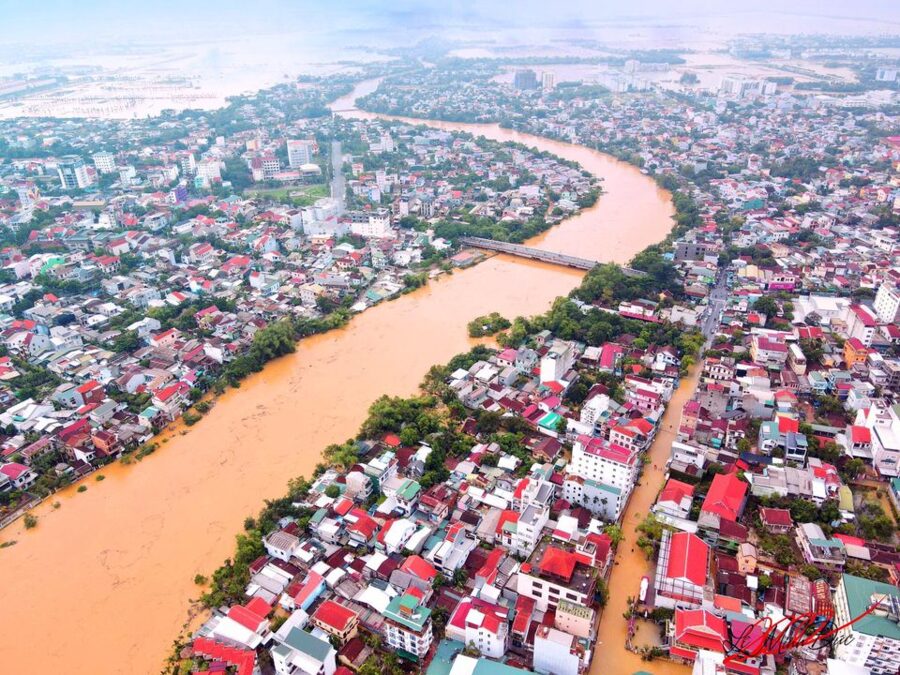

If you travel between late September and early December, keep a spare day, follow the national weather service’s forecasts, and check that the sites are open before you set out. The south is drying out by then, so it can be the better moment for the Mekong Delta and Phu Quoc.
The best months are February to April: dry, mild and green after the rains. From May to August average highs reach about 35°C in June and July, with a dry west wind off the mountains that locals call the Laos wind; do the tombs early and the museums after lunch. December and January are cool and often drizzly, with January highs around 23°C. The guide to the best time to visit Vietnam sets this against the rest of the country, and the Vietnam e-visa guide covers the entry paperwork.
Two days in Hue
| When | Day one | Day two |
|---|---|---|
| Early morning | Bún bò Huế, then the Imperial City at opening time | Car or Grab to Tu Duc and Dong Khanh |
| Late morning | Thai Hoa, Kien Trung, The Mieu, the corridors | Khai Dinh, before the heat |
| Afternoon | Rest, or the Royal Antiquities Museum if it rains | Minh Mang, then back to town |
| Evening | Dragon boat to Thien Mu for sunset | Cơm hến and chè, then a walk over Truong Tien Bridge |
Buy the four-site ticket on the first morning, since it covers both days. If the forecast shows heavy rain for one of them, swap the order: the Imperial City’s corridors keep you drier than any tomb on a hillside.
Be at the Meridian Gate when it opens. For the first hour the courtyards are cool and nearly empty, and you can stand in front of Thai Hoa Palace and hear nothing but birds.